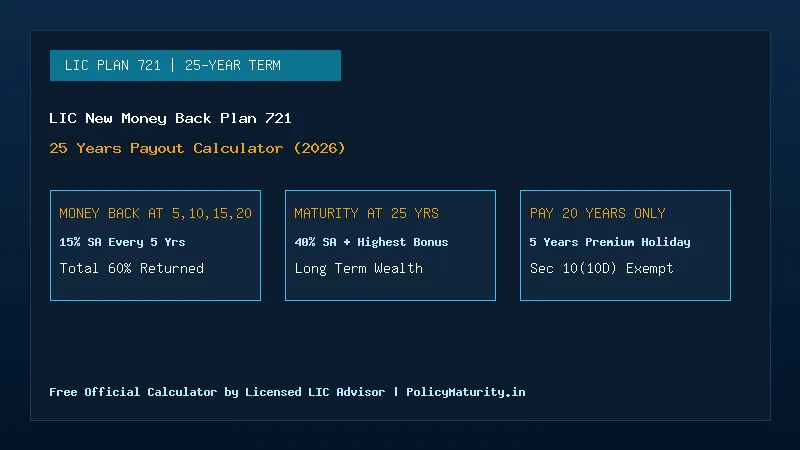
The twenty five year Money Back policy spreads its earlier payments across four dates. Each payment is smaller as a share of cover than in the twenty year version, and premiums continue for longer. Think about when you need the money before choosing between the two schedules on the basis of total benefits.
A longer term also means more paying years
People from thirteen to forty five years can join this version, with basic cover starting at two lakh rupees. The policy runs for twenty five years and premiums for twenty years. If that commitment reaches beyond your expected working years, check how you would meet the later payments before taking a new policy.
Four smaller payments before maturity
Each scheduled survival payment returns fifteen percent of basic cover, while forty percent remains as base maturity. Bonus money is considered separately and depends on what LIC declares under the policy. The Twenty Years Money Back calculator lets you compare a shorter term with fewer but larger scheduled payments as a share of cover.
Seventy five thousand rupees at each stage
For five lakh rupees of cover, each earlier payment is seventy five thousand rupees. Four such payments total three lakh rupees, leaving two lakh rupees as the base maturity payment at year twenty five. Any eligible bonus is added then, and should not be confused with a fixed yearly return on your premiums.
FAQ
Q: Which four anniversaries carry the fifteen percent payments?
A: They are the ends of the fifth, tenth, fifteenth and twentieth policy years, provided you survive and the required premiums have been paid.
Q: Does the longer term guarantee a bigger final additional bonus?
A: No. Any final additional bonus depends on LIC declarations and eligibility. A longer policy term alone does not guarantee a larger bonus.
Q: Does cover stop when the twentieth year premiums finish?
A: No. With all scheduled premiums paid, base cover continues through the remaining five years under the policy terms, until the maturity date.