Dhan Rekha is no longer offered for new purchases, but an existing policy still needs to be understood using its own terms. The earlier money-back payments and the final maturity amount are separate parts. If you add up the benefits, keep their dates beside them so the total does not hide the waiting time.
Read the payment option before the estimate
The plan had single-payment and limited-payment choices, and the age limits were not identical for both. That means the term alone is not enough to check eligibility. Use the payment choice recorded on your policy paper, especially if you are comparing an old quote with the result shown on this page.
Earlier payments do not reduce base maturity
For a fully maintained policy, earlier survival payments do not reduce the basic cover payable at maturity. This differs from plans that return only the remaining part of cover at the end. The New Money Back policy calculator shows that different structure, which is worth checking before comparing final amounts.
A twenty year Dhan Rekha example
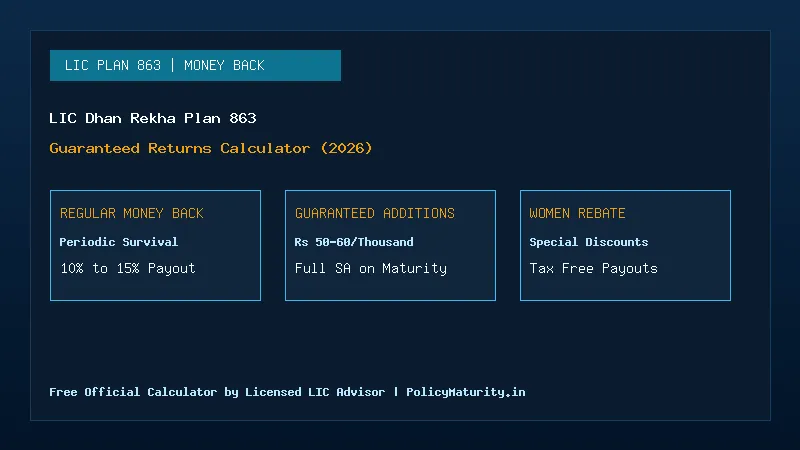
With five lakh rupees of cover for twenty years, the scheduled survival payments are fifty thousand rupees each at years ten and fifteen. Fixed additions from year six to year twenty total three lakh seventy five thousand rupees. Maturity is eight lakh seventy five thousand rupees, apart from those earlier payments.
FAQ
Q: Does every Dhan Rekha policy require payments for half its term?
A: The limited-payment option does: ten, fifteen or twenty years for the corresponding terms. The single-premium option uses one payment instead.
Q: Will earlier Dhan Rekha money-back payments be cut from maturity cover?
A: No. Under a fully maintained policy, the basic cover remains payable at maturity, with eligible fixed additions, despite those earlier survival payments.
Q: Can a woman’s Dhan Rekha premium differ from a man’s?
A: The plan provided different premium rates for female lives. Compare the original official quotes; this calculator does not ask for sex and cannot reproduce that difference.