Jeevan Utsav can suit someone who wants to finish premiums first and receive yearly money later. But finishing premiums does not mean the income starts the next day. The gap depends on the paying term, so check the first income year before you set a date for your retirement budget.
Choose the paying years and income date together
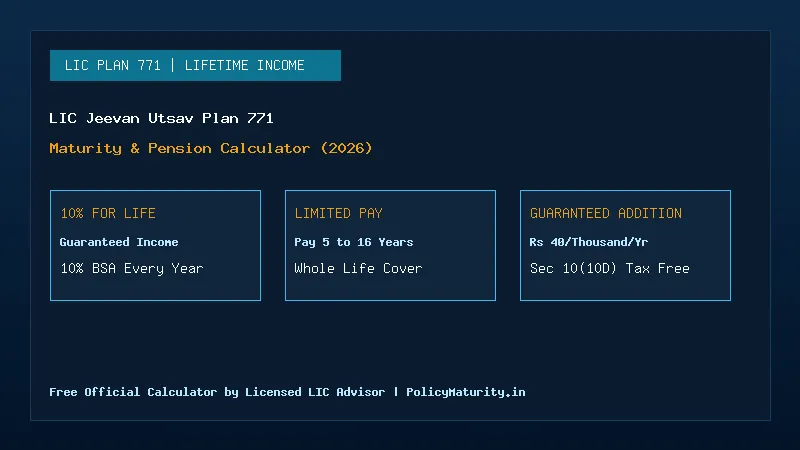
This policy starts with five lakh rupees of basic cover and lets you pay for five to sixteen years. The allowed joining age changes with that choice. For a child, the first income also has an age condition, so a short paying term may not be available at every age.
Regular money or the Flexi choice
Under the regular choice, the yearly income is paid when due; under the Flexi choice, you can leave it with LIC under the stated interest and withdrawal rules. Neither choice turns this into a policy with a normal maturity payout. Compare Jeevan Umang policy if maturity at a stated age matters to you.
What five lakh rupees of cover gives
Five lakh rupees of cover gives fifty thousand rupees of regular yearly income once payments become due. During each premium paying year, twenty thousand rupees also gets added under the fixed addition rule. That addition is not another yearly cash payment into your bank account, so keep the two amounts separate.
FAQ
Q: Does the Flexi choice pay interest on my full basic cover?
A: No. The five and a half percent yearly compound interest applies to eligible deferred Flexi income, not to the full cover or all premiums.
Q: If I pay for five years, when does my first Utsav income arrive?
A: For that paying term, the first income falls at the end of the eleventh policy year, subject to survival and payment conditions.
Q: Does the fixed forty rupees addition continue after premiums finish?
A: No. It is added for eligible premium paying years. It does not continue for every later year of life after that period ends.