New Children's Money Back spreads a child's savings benefit over several ages instead of paying everything at the end. For a parent, this makes the dates as important as the total: school fees, college fees and the final payment may fall in different years from the family's actual spending needs.
Match the child age to the payment dates
The child can join from birth up to twelve years of age, and the policy ends at twenty five. A younger entry age means a longer premium schedule, so check how long the parent can keep paying; the policy also passes into the child's ownership at eighteen under its terms.
Where the three early payments come from
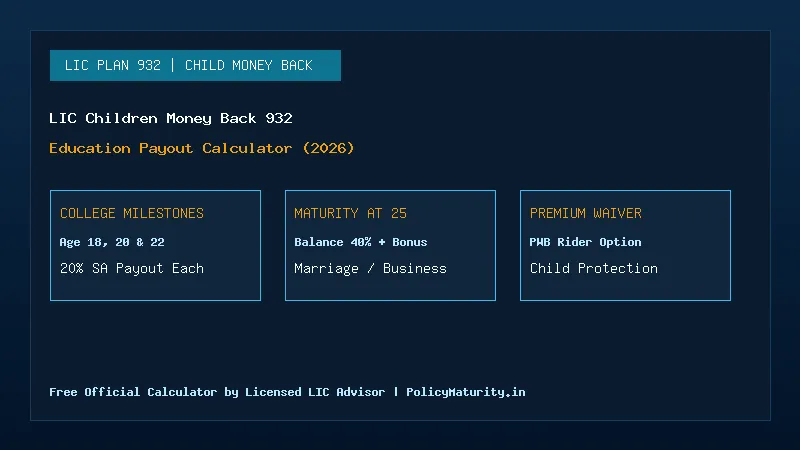
The three early payments each use twenty percent of the basic cover, with forty percent left for the final year. Bonuses are a separate part of this participating plan; parents who prefer a fixed addition can compare Amritbaal, where the benefit structure is different from these age based payments.
Five lakh cover split across four dates
With five lakh rupees basic cover, one lakh rupees comes at eighteen, another at twenty and another at twenty two, provided the policy remains eligible. Two lakh rupees of basic cover remains for age twenty five, with applicable bonus money added then; these figures do not mean that every premium earns that same rate.
FAQ
Q: Are Children's Money Back payments tied to policy anniversaries alone?
A: They follow the stated child ages and the policy terms. Check the actual due dates in the schedule rather than counting a fixed number of years from purchase.
Q: Can the child leave a scheduled money back payment with LIC?
A: The plan permits a choice to delay survival payments under its rules. Ask LIC for the applicable interest and request process before relying on a later amount.
Q: Does this child plan automatically insure the parent's income?
A: No. The insured child and the parent are different people. An eligible premium waiver rider can help with future premiums if its separate claim conditions are met.