Jeevan Lakshya is often discussed for a child’s future, but the adult named as the insured person is the life covered by the plan. This matters when you read the family income rule. The benefit depends on a covered death of that person, not simply on being the child’s parent.
Whose life is covered by this policy?
The joining age is eighteen to fifty years, and the policy term must fit the maturity age limit. You pay for three years less than the policy term you choose. Before planning for school or college fees, put the expected expense date beside the actual maturity date on your policy paper.
Family income after a covered death
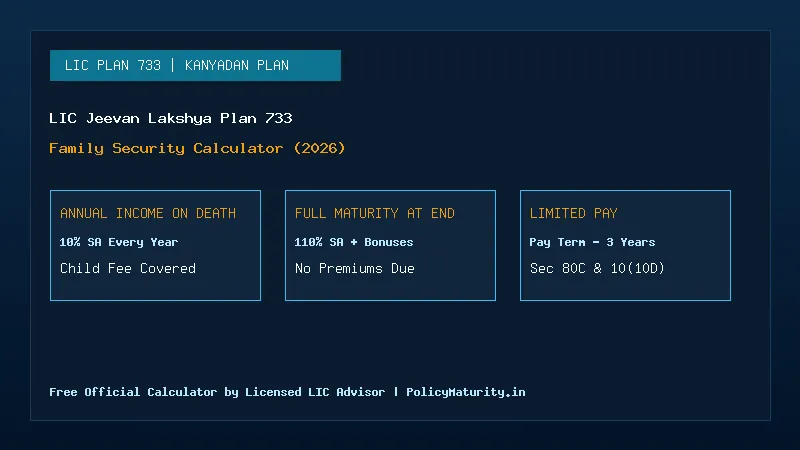
If the insured person dies during the term under the covered conditions, the policy provides family income on the stated anniversaries and a payment at the original maturity date. Future base premiums are not required after that covered death. For a policy on the child’s own life, compare the Amritbaal child policy calculator.
The difference between five lakh and five lakh fifty thousand
On five lakh rupees of cover, the family income component is fifty thousand rupees for each eligible year after a covered death. The scheduled cover component at the original maturity date is five lakh fifty thousand rupees. If the insured person survives instead, base maturity is five lakh rupees, with eligible bonuses added.
FAQ
Q: When does the family’s yearly Lakshya income begin?
A: It starts on the policy anniversary coinciding with or following the covered death, and runs to the anniversary before the original maturity date.
Q: How long do I pay for a twenty one year Lakshya term?
A: You pay for eighteen years. The remaining three years are part of the policy term, provided the required premiums have been paid.
Q: Do I receive one hundred and ten percent simply by surviving?
A: No. That component belongs to the death-benefit arrangement. Normal survival maturity uses the basic cover and eligible bonuses under the policy terms.