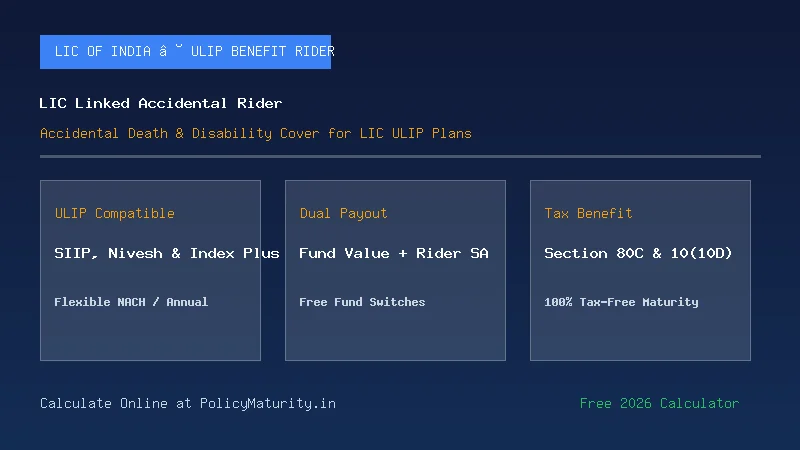
Linked Accident Rider pays for extra accidental death protection through charges taken from an eligible market-linked policy's fund. The point that often causes confusion is the rate period: a charge can be collected each month even though the stated price is a yearly rate, which changes the cost calculation greatly.
Monthly collection does not mean a monthly quoted rate
The rider needs an eligible active policy and must meet its entry age, remaining term and cover limits before it can be attached. Check the main policy's allowed dates for adding or removing it, because the existence of an online calculator does not mean the rider can be changed on any day.
Fund units pay for the extra accident cover
LIC cancels the required fund units to collect the monthly share of the accident charge, so the cost reduces the units held even without a separate premium bill. You can read Nivesh Plus for a linked-policy example, while checking that your particular contract permits the rider.
Ten lakh cover and the annual charge
At forty paise a year for each one thousand rupees of rider cover, ten lakh rupees cover costs four hundred rupees a year before applicable adjustments. Its monthly share is about thirty three rupees and thirty three paise, not four hundred rupees each month; special occupation pricing must be checked separately.
FAQ
Q: Is the Linked Accident Rider forty paise rate charged in full every month?
A: No. The stated standard rate is yearly, with one twelfth collected monthly from units. Applying the full yearly rate each month would greatly overstate this charge.
Q: Does this linked rider always add cover to the fund value alone?
A: Its accepted accident benefit is additional to the base policy death benefit. That base benefit follows its own formula and is not necessarily just the fund value.
Q: Can I remove or add the linked accident rider without checking my ULIP?
A: No. Use the attachment and removal rules of the rider and main policy, including age and remaining-term conditions, and have LIC confirm the effective date.