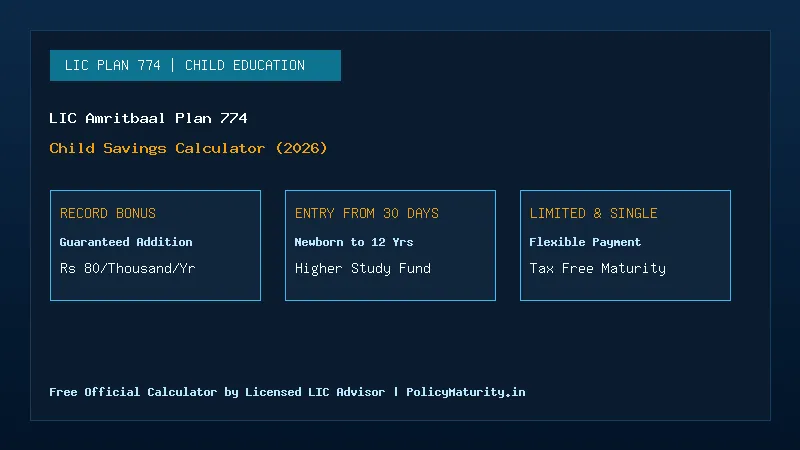
Amritbaal helps parents set aside money for a child with a fixed addition written in the policy paper. The useful question is when the child will need that money, because a payment after college starts may arrive too late for the first fees even when the final amount looks good.
Choose the age when your child needs money
A child can enter Amritbaal from thirty days up to thirteen years of age, with maturity between eighteen and twenty five years. Choose the end age first, then check which paying years fit that choice, rather than assuming every child can have the same policy length or premium amount.
How the fixed amount builds in Amritbaal
In Amritbaal, eighty rupees gets added each year for every one thousand rupees of basic cover while the policy stays fully in force. This is a fixed policy benefit rather than a share of future profits; compare Jeevan Tarun if you want scheduled payments before the final year.
A five lakh rupees child savings example
For five lakh rupees basic cover, the yearly addition is forty thousand rupees, so twenty full policy years add eight lakh rupees. The maturity amount then becomes thirteen lakh rupees if all due premiums are paid and the policy reaches its end; that is a benefit example, not the return on each premium.
FAQ
Q: Does Amritbaal depend on LIC declaring a yearly bonus?
A: No. Its fixed addition follows the amount written in the contract while the policy is in force; you do not wait for a future profit bonus declaration.
Q: Can I choose an Amritbaal end date after my child turns twenty five?
A: No, the stated maturity age range ends at twenty five. Match the chosen age with school or college needs before you agree to the premium schedule.
Q: Will Amritbaal stop asking for premiums if the parent dies?
A: Do not assume so. Parent death protection needs the eligible extra premium waiver option and its own conditions; the child policy alone does not promise it.